What Is a Veterinary Criticalist? When Your Pet Needs ICU-Level Care | Vetmodo
Specialty Care
What Is a Veterinary Criticalist (DACVECC)? The ICU Specialist Fighting for Your Pet's Life
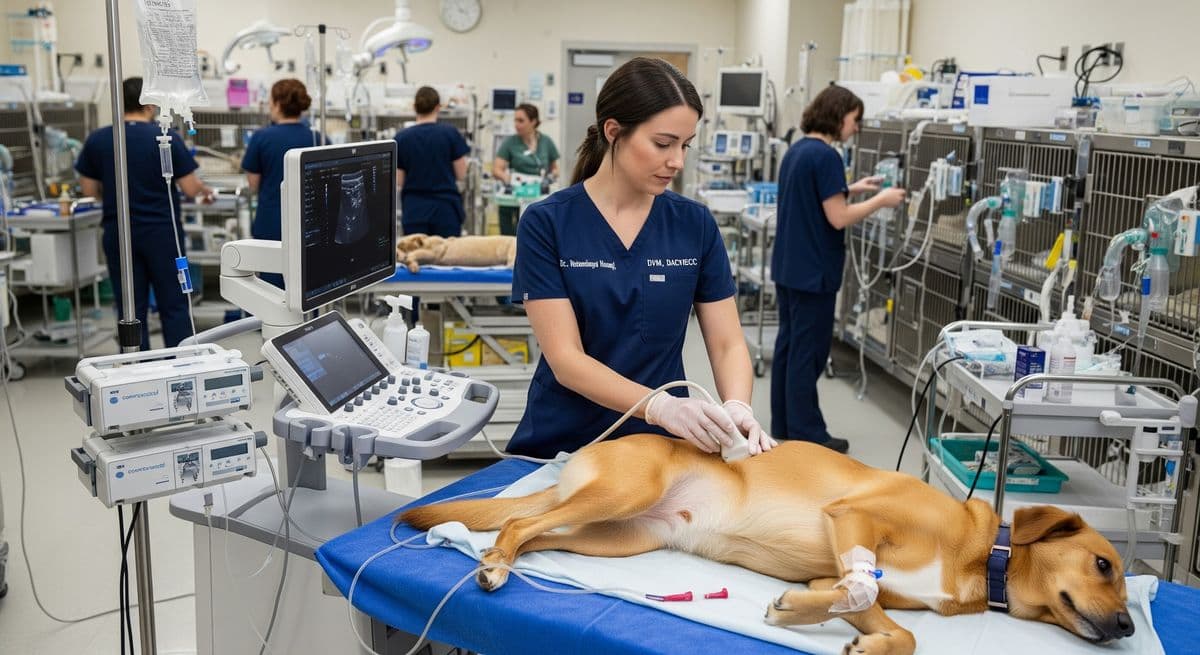
When a pet's condition is too complex, too unstable, or too life-threatening for standard emergency care, a veterinary criticalist steps in. These board-certified ICU specialists manage the sickest patients minute-to-minute — coordinating every organ system, every medication, and every specialist in the building. Here's what they do, and how to know when your pet needs one.
Reviewed by Jonathan Schaefer
Key takeaways
A veterinary criticalist (DACVECC) is a board-certified specialist who completes a one-year internship followed by a three-year residency after veterinary school, focusing exclusively on life-threatening illness and multi-organ failure.
Beyond the ICU, criticalists are as much teachers as they are clinicians: their evidence-based training elevates the standard of medicine practiced by every member of the veterinary team.
Criticalists are expertly trained in the physiology of health and pathophysiology of disease to manage a wide variety of complex, life-threatening diseases, especially ones that "don't read the textbook."
Critical care is the foundation that makes all other veterinary specialties succeed: they optimize care for complex cases managed by other specialists, allowing other veterinarians to attend to more cases
Introduction: The Specialist Behind the Scenes When Stakes Are Highest
Trust you can count on.
Articles identify their authors, reviewers, publication dates, and supporting sources when that information is available.
When a pet is rushed to an emergency clinic, most owners are focused on one thing: getting their animal seen as fast as possible. The emergency veterinarian stabilizes, triages, and acts. But what happens when the crisis doesn’t resolve in an hour? When a pet’s organs start to fail, when a dog develops sepsis after surgery, or when a cat can’t breathe without a machine?
That’s when a different specialist steps in. A veterinary critical care specialist ("criticalist") is the specialist of the ICU, the veterinarian trained to manage pets whose conditions are so complex and unstable that they require expert, continuous oversight around the clock. Emergency and critical care medicine is the physiological foundation of modern veterinary practice, providing the stabilization necessary for all other medical and surgical specialties to succeed. (Mathews, 2017)
What Is a Veterinary Criticalist? The DACVECC Explained
A veterinary criticalist holds the credential DACVECC ( Diplomate of the American College of Veterinary Emergency and Critical Care). Earning this designation requires completing veterinary school, followed by a one-year internship, followed by an intensive three-year residency focused specifically on advanced life support, multi-organ failure, and complex trauma. It is one of the most demanding training pathways in veterinary medicine.
Criticalists work primarily in the Intensive Care Unit (ICU), but their role extends far beyond it. They function as the “glue of the hospital” - essential consultants who collaborate with surgeons, internal medicine specialists, cardiologists, and neurologists to manage the physiological complexities of the most difficult cases. When a pet is in the ICU after major surgery, it is often the criticalist who is watching the body’s moment-to-moment response and adjusting treatment accordingly. (Mathews, 2017)
ℹ Emergency vet vs. veterinary criticalist — what’s the difference?
An emergency veterinarian handles immediate, walk-in stabilization: the first responder of veterinary medicine. They assess, triage, and intervene in the acute phase of an illness or injury, often preventing deterioration or death that may have happened otherwise.
A veterinary criticalist takes over when a pet’s condition is too complex, too unstable, or too multi-systemic to resolve quickly. They manage the ICU, lead the medical team, and make the continuous adjustments that keep a failing body functional long enough to recover.
Think of it this way: the ER vet gets your pet through the door alive. The criticalist keeps them alive for the days that follow.
When Does a Pet Need a Veterinary Criticalist?
A criticalist becomes the primary lead when a pet’s condition is so complex that it requires minute-to-minute intervention and high-level technical monitoring. Some of the most common scenarios include:
Sepsis and multi-organ dysfunction: When infection spreads systemically and begins to compromise multiple organ systems simultaneously — including the liver, kidneys, and cardiovascular system — a criticalist coordinates the intensive medical management required to support each failing system. (deLaforcade et al., 2022)
Severe respiratory failure: Pets in acute respiratory distress — including those who may require mechanical ventilation or advanced oxygen therapy — need the specialized oversight of a criticalist to safely manage airway support and pulmonary function. Acute Respiratory Distress Syndrome (ARDS) in veterinary patients is a life-threatening condition requiring precisely this level of expertise. (Balakrishnan et al., 2025); (Cagle et al., 2022)
Coagulation abnormalities and transfusion medicine: Life-threatening clotting disorders — such as disseminated intravascular coagulation (DIC) — require sophisticated management of blood products and anticoagulation therapy that falls squarely within the criticalist’s expertise. (deLaforcade et al., 2022)
Major trauma: Pets that have sustained serious physical trauma — hit by a car, falls from height, or severe lacerations — require coordinated, intensive recovery management that goes well beyond initial stabilization. The ACVECC Veterinary Committee on Trauma Registry documents the scope and outcomes of these cases at referral centers. (Wedig et al., 2025)
Severe toxicities: When a pet has ingested a dangerous toxin that affects multiple organ systems, a criticalist manages the systemic response with targeted interventions while monitoring for complications.
Post-operative intensive monitoring: After major surgery, a criticalist oversees the ICU recovery phase, watching for complications such as fluid shifts, cardiovascular instability, pain crises, and infection.
Multi-specialty coordination: When a case involves surgery, cardiology, internal medicine, and neurology simultaneously, the criticalist serves as the central clinical anchor — the one specialist who sees the entire patient rather than a single organ system. (Mathews, 2017)
The Science of “Rational Care”: Why More Treatment Isn’t Always Better
One of the most important concepts in veterinary critical care is one that surprises many pet owners: more treatment is not always better treatment. In the ICU, the therapeutic window is narrow. Too little intervention and the patient deteriorates. Too much; too much fluid, too many medications, too aggressive an approach, and treatment itself causes harm.
Criticalists are trained to navigate this narrow window with precision, applying evidence-based consensus guidelines to deliver exactly what each patient’s body needs at each moment in time. This is the art and science of “rational care”: a constant metabolic balancing act performed by a specialist who understands the physiology of failing organ systems in real time. (deLaforcade et al., 2022)
For example, one of the most dangerous complications in critically ill patients is fluid overload, where aggressive IV fluid therapy, while initially necessary, crosses into causing lung damage and cardiovascular stress. Criticalists monitor for this balance continuously and adjust fluid protocols in real time. (Cavanagh et al., 2016)
Teaching and Mentorship: Raising the Standard of Care Hospital-Wide
Criticalists are as much teachers as they are clinicians. Their deep grounding in evidence-based medicine positions them to elevate the standard of care practiced by every member of the veterinary team around them. In academic and referral hospital settings, criticalists routinely mentor interns, residents, and general practitioners — translating the latest consensus guidelines into daily clinical practice. This includes areas such as rational antibiotic prescribing (Stewart & Allen, 2019), resuscitation protocols, and nutritional support for critically ill patients. The result is a hospital culture where evidence informs every decision, not just in the ICU, but across every department a critically ill patient touches.
What Does a Veterinary Criticalist Actually Do? The Full Picture of ICU Management
A criticalist does not look at a single symptom or a single organ. They manage the entire clinical picture of a critically ill patient, integrating every facet of care into a single cohesive plan:
Precision fluid therapy: Balancing hydration needs against the very real dangers of fluid overload - one of the most common and serious complications in ICU patients. (Cavanagh et al., 2016)
Cardiovascular and organ support: Using advanced pharmacology, including vasopressors, to maintain blood pressure and support failing cardiovascular or renal function. (Murphy et al., 2022)
Nutrition support: Implementing early enteral (tube feeding) or parenteral (IV nutrition) feeding to provide the fuel the immune system and healing tissue require. Early nutritional intervention in critically ill dogs is associated with improved outcomes. (Holahan et al., 2010)
Multi-modal pain management: Ensuring a patient is kept comfortable through sophisticated, layered analgesic protocols - because pain itself worsens physiological stress and impairs recovery.
Targeted antimicrobial therapy: Applying the latest antimicrobial stewardship guidelines to treat severe infections effectively while minimizing the development of antibiotic resistance, a growing concern in both human and veterinary medicine. (Stewart & Allen, 2019)
Respiratory management and ventilation: Overseeing oxygen therapy, positive-pressure ventilation, and management of acute respiratory distress syndrome (ARDS), one of the most technically demanding aspects of critical care. (Balakrishnan et al., 2025); (Cagle et al., 2022)
CPR and resuscitation protocols: Criticalists lead cardiopulmonary resuscitation efforts using the most current evidence-based guidelines, including the RECOVER CPR recommendations that define best practice in veterinary resuscitation. (Burkitt-Creedon et al., 2024)
Transfusion medicine and coagulation intervention: when blood or plasma transfusions are needed, the dose should be tailored for the patient. Criticalists are trained how and when to provide these life-saving measures, along with addressing clotting disorders.
Continuous advanced monitoring: Detecting small physiological changes before they become major crises - the fundamental advantage of ICU-level care. This includes blood pressure monitoring, blood gas analysis, coagulation assessment, and continuous electrocardiography (ECG).
How to Find a Veterinary Criticalist or ICU for Your Pet
Veterinary criticalists practice primarily at specialty and emergency referral hospitals, facilities with the equipment and staffing to provide 24-hour ICU care. If your primary care veterinarian believes your pet needs critical care management, they will typically refer you directly.
In an emergency, useVetModo.com to quickly locate specialty and emergency veterinary hospitals in your area that offer ICU services staffed by or supervised by board-certified critical care specialists (DACVECC).
Final Thoughts: Critical Care Is the Safety Net Every Pet Deserves
Most pet owners will never need a veterinary criticalist. But when a pet’s life hangs in the balance - when the situation is too complex, too unstable, or too multi-systemic for standard emergency care - knowing that this level of expertise exists, and knowing how to access it, can change the outcome.
The DACVECC credential represents years of specialized training dedicated to one purpose: keeping the sickest patients alive long enough to recover. By managing the entire clinical picture and serving as the physiological anchor for the entire medical team, a veterinary criticalist gives even the most critical cases their best possible chance to go home. (Mathews, 2017)
Medical disclaimer
This article is educational and does not replace advice, diagnosis, or treatment from a licensed veterinarian. Contact your veterinarian with questions about your pet's health.