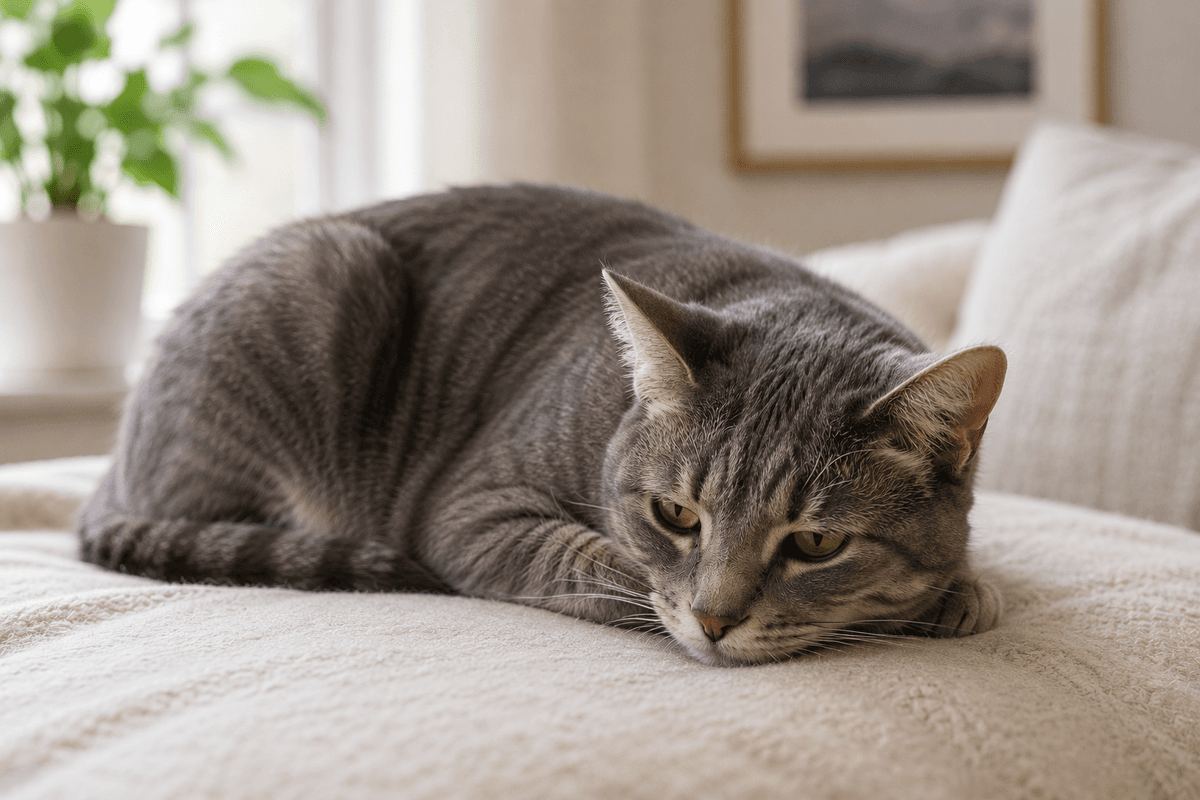
It's easy to dismiss a cat who vomits once a week as just having a sensitive stomach, especially if they're eating, playing, and acting like themselves the rest of the time. But regular, recurring vomiting, even at what feels like a low frequency, isn't something cats are simply supposed to do. It's frequently a sign that something underlying is going on.
There's a persistent myth that vomiting is just part of being a cat. In reality, a comprehensive literature review on vomiting disorders in cats emphasizes that recurring vomiting typically reflects an identifiable underlying cause, whether gastrointestinal or otherwise, rather than being a normal baseline behavior (Batchelor et al., 2013). Once vomiting becomes a regular, recurring pattern rather than an isolated event, it crosses into what veterinarians consider chronic vomiting, which warrants investigation.
One of the most common underlying causes of chronic, low-frequency vomiting in cats is chronic enteropathy, an umbrella term for ongoing inflammatory or functional disease of the gastrointestinal tract. Research examining the causes and diagnostic approach to chronic vomiting in cats found that gastrointestinal disease was a leading cause, and that meaningful diagnostic information could often be gathered through a structured workup rather than guesswork (Hauck et al., 2016). The tricky part is that chronic enteropathy doesn't always look dramatic. It can show up as nothing more than an occasional vomiting episode, easy to miss or dismiss precisely because it isn't severe.
One of the more unsettling aspects of chronic GI disease in cats is how well they can mask it. A study evaluating the diagnosis of chronic small bowel disease in cats found that many affected cats had been showing subtle signs, including intermittent vomiting, for extended periods before a diagnosis was made (Norsworthy et al., 2013). A review of diagnostic and therapeutic approaches to chronic enteropathies in cats similarly notes that these conditions often progress slowly and subtly, allowing affected cats to appear largely normal between episodes for a long time (Ewald et al., 2021). This is exactly why "my cat seems fine" isn't a reliable reason to skip a vet visit if the vomiting itself is a recurring pattern.
Chronic, low-frequency vomiting in cats can stem from a range of underlying conditions, including:
- Food sensitivities or dietary intolerance
- Inflammatory bowel disease, a common form of chronic enteropathy in cats (Jergens, 2012)
- Frequent hairball formation linked to an underlying motility or inflammatory issue, rather than simply excess grooming
- Low-grade gastrointestinal lymphoma, a slow-growing cancer that can closely resemble inflammatory disease both clinically and on some testing (Marsilio et al., 2023)
Because several of these conditions can look nearly identical from the outside, and sometimes even on initial testing, a proper veterinary workup is generally the only reliable way to determine what's actually driving the vomiting.
It's common for owners, and even some veterinarians, to write off occasional vomiting as simply hairballs. A review specifically examining hairballs in cats challenges this assumption, noting that frequent hairball vomiting can actually be a sign of an underlying motility disorder or gastrointestinal disease, rather than a harmless grooming byproduct (Cannon, 2013). In rare but serious cases, hairballs can also become large enough to cause a genuine intestinal obstruction; a case series describing intestinal obstruction from trichobezoars in cats illustrates just how significant this complication can become when it does occur (Barrs et al., 1999). None of this means every hairball is cause for alarm, but a pattern of frequent hairball vomiting is worth mentioning to your veterinarian rather than assuming it's simply normal cat behavior.
Chronic gastrointestinal inflammation in cats doesn't always stay contained to the gut. Because the pancreas, liver, and intestines sit in close proximity and are functionally interconnected in cats, ongoing GI inflammation can contribute to related conditions like pancreatitis or triaditis, a combined inflammation of the intestines, pancreas, and liver. Left unaddressed, what starts as intermittent, seemingly mild vomiting can escalate into a more acute, more serious flare-up requiring more intensive treatment than would have been needed with earlier intervention.
Perhaps the most compelling reason not to dismiss chronic low-frequency vomiting is the relationship between long-standing inflammatory bowel disease and low-grade, or small-cell, gastrointestinal lymphoma. Consensus guidelines from the American College of Veterinary Internal Medicine describe how distinguishing low-grade neoplastic disease from inflammatory chronic enteropathy can be genuinely difficult, since the two can look remarkably similar clinically and require specific diagnostic approaches to differentiate (Marsilio et al., 2023). While not every cat with chronic vomiting is on a path toward lymphoma, the possibility that long-term, unaddressed inflammation could eventually progress is one more reason early evaluation matters.
If your cat has a pattern of vomiting roughly once a week, your veterinarian has several tools available to investigate further, which may include:
- Bloodwork to evaluate organ function and rule out other contributing conditions
- Fecal testing to check for parasites or other gastrointestinal culprits
- GI-specific blood panels, such as cobalamin and folate levels, which can point toward small intestinal disease
- Abdominal imaging to evaluate the intestines, pancreas, and liver
- In some cases, biopsy, either via endoscopy or surgery, to determine whether inflammation or something more concerning, like lymphoma, is present
A structured diagnostic approach, rather than trial and error, tends to get to an answer faster and with less guesswork (Hauck et al., 2016).
Not every case requires jumping straight to advanced diagnostics. Depending on your cat's history and exam findings, your veterinarian may start with a therapeutic diet trial. Research evaluating hydrolyzed diets for cats with vomiting or diarrhea in general veterinary practice found this approach to be a reasonable and often effective starting point for many cats (Kathrani et al., 2020). Other studies evaluating commercial therapeutic diets specifically formulated for chronic gastroenteropathy have also found meaningful improvement in clinical signs for many cats (Perea et al., 2017). If a diet trial doesn't resolve the vomiting, that itself is useful diagnostic information that helps guide the next steps.
Once a treatment plan is underway, monitoring matters just as much as the initial diagnosis. Research has found that successful treatment of chronic enteropathy in cats is associated with a measurable decrease in fecal calprotectin, a marker of intestinal inflammation, giving veterinarians an objective way to track whether a treatment plan is actually working (Heilmann et al., 2024). Longer-term outcome data on cats with chronic inflammatory enteropathy also suggests that many cats do well with appropriate diagnosis and management, which is an encouraging reason to pursue a workup rather than simply living with recurring vomiting indefinitely.
If your cat has been vomiting on a regular basis, even infrequently, it's worth having a veterinarian take a closer look. Vetmodo makes it easy to find local veterinarians who can evaluate your cat's symptoms, recommend appropriate testing, and help you get to the bottom of what's really going on. Search Vetmodo today to find a vet near you.