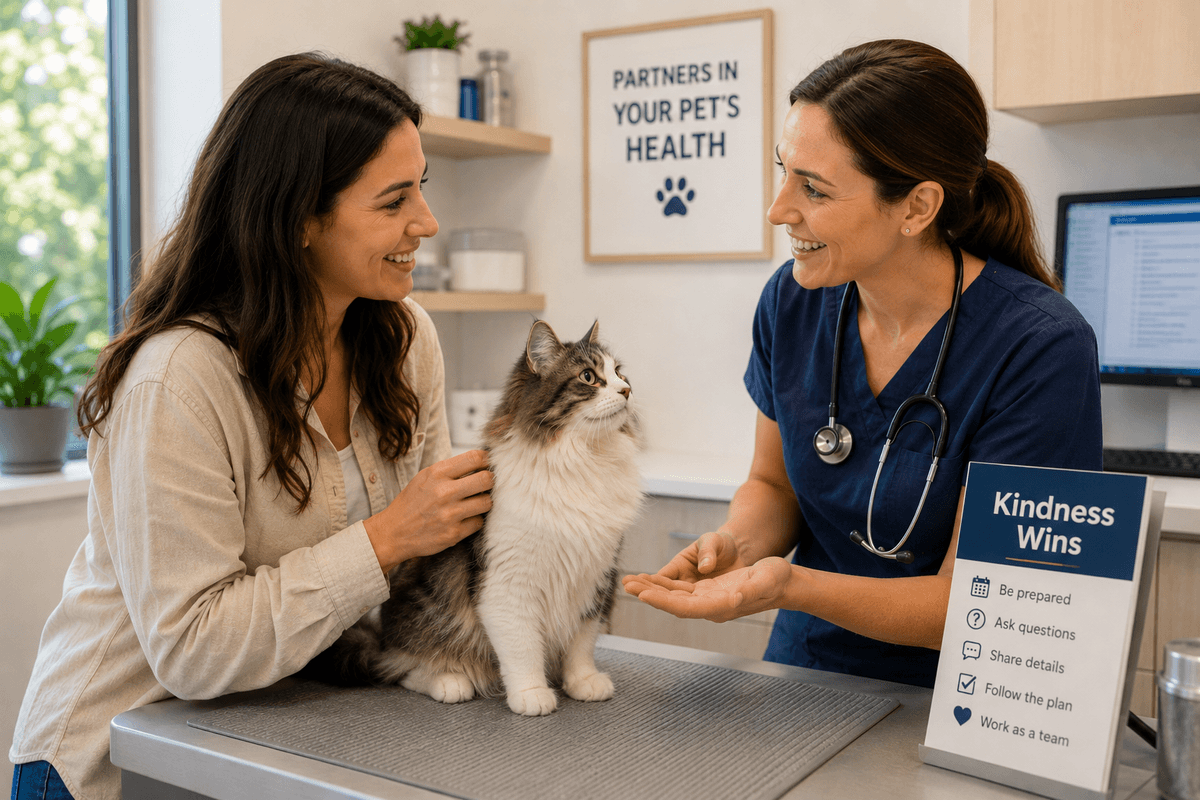
Ever wonder what your veterinary team wishes you knew? From getting your pet comfortable with the clinic to coming prepared and keeping communication simple, these insider tips help every appointment go more smoothly, for you, your pet, and the people caring for them.
5 min read
Reviewed by Jonathan Schaefer, Diplomate, American College of Veterinary Emergency and Critical Care
Written by Vetmodo Editorial Team
Key takeaways
Kindness won't change the quality of your pet's medical care, but a good relationship makes your whole team experience that much better
A little preparation goes a long way: get your pet used to the clinic early, and come with a clear history of symptoms, medications, and diet changes.
For anything complex, designate one point of contact so the team can share the full picture once, rather than repeating it to several people.
Being upfront about your budget and asking thoughtful questions leads to better, shared decisions about your pet's care.
Want to know the trade secrets nearly every veterinarian wishes pet owners knew? There are a few simple things you can do to get the most out of every visit.
1. Being Kind May Earn Some Extra Brownie Points
Let's be completely clear on this, because it matters: being a nice client does not get your pet better medical care. As veterinarians, we hold ourselves to the same high standard for every single patient, every time, regardless of how the interaction goes. Your pet gets our best either way.
Trust you can count on.
Articles identify their authors, reviewers, publication dates, and supporting sources when that information is available.
We all have those owners who leave us thinking, "What a nice person." Nearly every vet is a perfectionist who wants to do the best possible job for every patient. And we are also human, and we connect with certain people who genuinely brighten our day. If you can be that person for your veterinary team, it is human nature to want to return that kindness. And kindness often comes full circle.
We also recognize that everyone has bad days, and that a trip to the vet is rarely anyone's idea of a good time. It's part of caring for a pet, not something people look forward to. But take a moment before you walk in to remember that everyone on the other side of that door is there because they want to be, and they want to help you.
2. Get Your Pet Comfortable with the Vet Office Early
We all understand that animals get stressed coming to the vet. That is par for the course, and we expect it from nearly every cat, dog, or other non-biped who walks (or flies) through the door. Animals would simply rather be home. But there are things you can do to help your pet feel more at ease.
Every dog we do not have to muzzle or sedate for an exam is a win. We want to practice fear-free, low-stress medicine and make the experience as positive as possible for pets and owners alike. You can help by starting early:
Gently handle their paws, ears, and the inside of their mouth at home, so being touched there feels normal
Bring them by the clinic for "social visits," where they simply come in, step on the scale, and get treats and praise (just arrange these with the hospital ahead of time)
The goal is to make the environment familiar, so that when the "scary stuff" eventually happens, your pet is already used to the place. It lowers their stress, reduces the steps our staff has to take, and everybody wins.
And if they are known to become stressed at the vet’s office, give your vet a heads up. There are “chill” protocols out there to help take the edge off prior to the appointment (Costa et al., 2023).
3. Have the Necessary Information Ready
If you are an existing client, your pet's medical records are likely already in our system. But if you are a new client, or this is a new problem, having the key details ready up front helps us give you the most accurate assessment and plan.
For most visits, that means a concise description of:
What has been going on, and when it started
What symptoms you have noticed
What medications or supplements your pet is taking
Any recent changes in diet
And if you are new to the practice, it also helps to bring:
A list of your pet's past medical problems and medications
The names of any veterinary hospitals that treated them before
4. Designate One Point of Communication
This one might be the most important, especially for complex cases: have a single person the veterinarian can talk to. Ideally, we get all the information we need from one point of contact, and then deliver our assessment and recommendations back to that same person, or group of people.
Here's the situation we run into. We go through the entire history and plan with one owner, and right at the end we hear, "Oh, do you mind explaining all that to my wife?" (husband, looking at us expectantly). We absolutely want everyone involved to be well informed, but ideally we only have to explain it once. When multiple caregivers can't be there together and we're asked to repeat the same detailed conversation several times, it becomes a real drain on the team's time.
So if more than one person shares in your pet's care, try to organize ahead so everyone can be there, in person or on the phone, for that one conversation. We understand there are exceptions where this simply isn't possible, and those are no problem at all. It's the preventable version we're gently asking you to help us avoid.
5. Be Upfront About Finances
This ties back to the first point: vets want to do the best job possible for every patient, every time, and we know finances are part of that equation. We deal with the same realities in our own lives, so we understand that every pet owner's situation is unique. Our goal is to practice the highest standard of medicine that is reasonable and feasible for you and your pet.
Many practices aim to offer what is called a spectrum of care, meaning we present different diagnostic and treatment options depending on the severity and complexity of the case (Brown et al., 2021). When you are open with us about your budget, sometimes even before we ask, it lets us problem-solve and map out a path that works, whether that's here at our hospital or by referring you elsewhere.
And if you have pet insurance, tell us up front so we can help make submitting your claim as easy as possible. Giving us a framework to work within lets us get creative and problem-solve right alongside you.
6. Ask Questions and Work with Your Veterinarian
With how common AI has become, many owners now arrive already knowing something about their pet's condition. We recognize that Dr. Google and ChatGPT offer a wealth of information that is sometimes accurate and sometimes not, but it can be a great launching pad for discussion when treated as exactly that.
Veterinarians increasingly use a team-based, coordinated-care approach rather than simply telling you what to do. We aim to explain the situation and our recommendations clearly enough that you can make an informed decision, which leads to a shared approach to your pet's care. Part of that is asking good questions when you are unsure. This is not about challenging your veterinarian, but about:
Asking them to explain their reasoning so you fully understand it
Offering your own perspective based on what you know
It goes both ways, and when both sides engage respectfully, the result is the same thing everyone wants: the right care for your pet, and an owner who feels confident in the decision they made.
7. Thank the Whole Team, Not Just the Vet
That means the technicians, the assistants, the front desk, and the hospital manager if you cross paths with them. Every person at a veterinary hospital is united by one thing: they love and care about animals. At the end of the day, we each run through a mental checklist of the cases we saw and the impressions they left on us.
Every staff member plays a part in your pet's care from the moment you walk through the door, and many of them do not get nearly as much recognition as they deserve. When an owner thanks a technician or the front desk, it does not just make that person's day, it gets back to the veterinarian. We notice how owners treat our whole team. Someone being kind to us but short with reception can actually leave a more bitter taste than anything.
A simple thank-you to anyone on the team, even someone who does not seem directly involved, goes a long way.
Because they care about you and your pet.
We all do.
Frequently Asked Questions
How can I make my dog or cat less stressed at the vet?
Start early by getting them comfortable with handling at home, gently touching their paws, ears, and mouth, and by bringing them for short "social visits" where they just step on the scale and get treats. Arrange these with the clinic ahead of time so the environment feels familiar before any "scary stuff" happens.
What information should I bring to a vet appointment?
A concise history helps most: what's been going on and when it started, the symptoms you've noticed, any medications or supplements, and recent diet changes. If you're new to the practice, also bring a list of past medical problems and the names of any previous veterinarians or hospitals.
Does being nice to my vet actually get my pet better care?
No. A good veterinary team holds itself to the same high medical standard for every patient, regardless of the interaction. What kindness can do is build goodwill that makes the team more willing to accommodate scheduling requests and go out of their way on the things around your pet's care. However, better communication can lead to improved shared decision making, which may ultimately result in better outcomes for patients.
Why do vets want just one person to talk to about my pet?
For complex cases, having a single point of contact means the veterinarian can gather the full history and share their assessment once, clearly, rather than repeating the same detailed conversation with several caregivers. If multiple people are involved, try to have everyone present or on the phone for that one conversation.
Written by
Vetmodo Editorial Team
Medical disclaimer
This article is educational and does not replace advice, diagnosis, or treatment from a licensed veterinarian. Contact your veterinarian with questions about your pet's health.