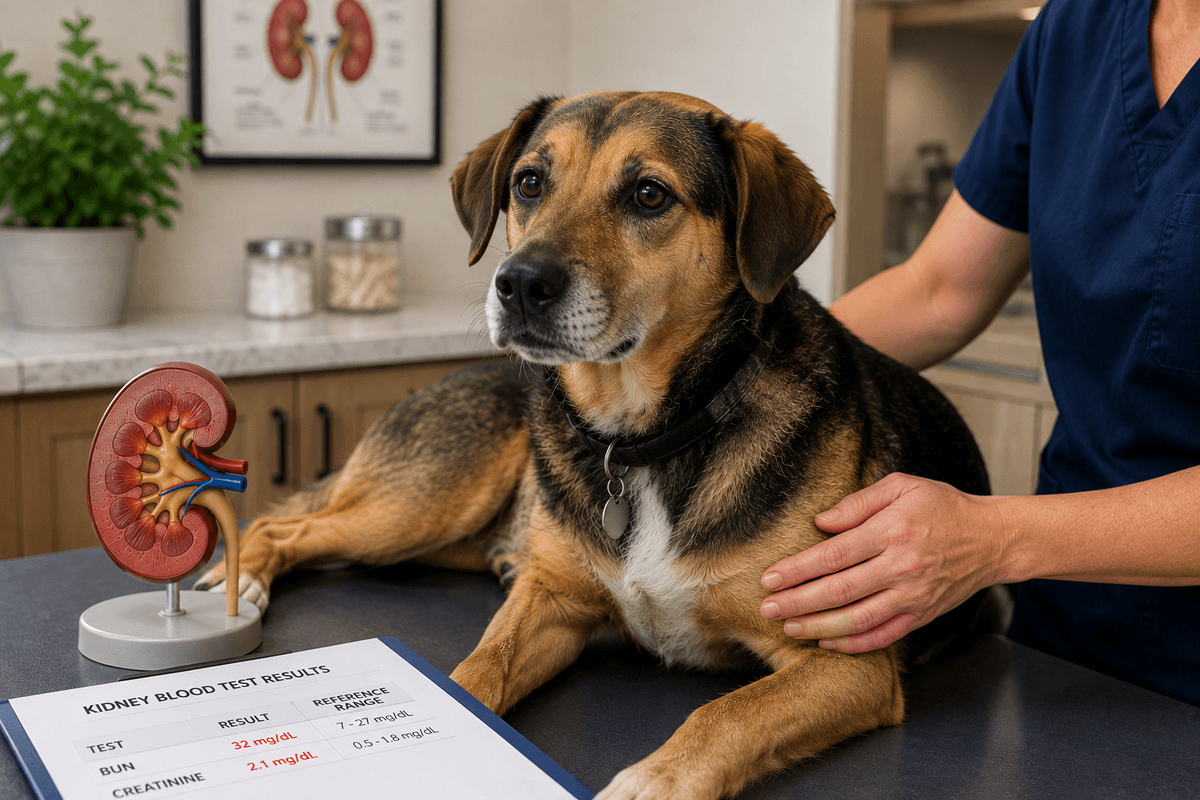
Hearing that your dog's kidney values are elevated is one of the more common, and more confusing, moments in a pet owner's relationship with veterinary bloodwork. These numbers matter, but they're often misunderstood, particularly how much kidney function can be lost before they even change. Here's what's actually going on.
Your dog's kidneys filter waste products out of the bloodstream, and the most commonly measured kidney values, creatinine, blood urea nitrogen (BUN), and symmetric dimethylarginine (SDMA), are all indirect measures of how well that filtration process is working. A review of renal biomarkers in companion animals outlines how each of these markers reflects kidney function slightly differently, and why using more than one in combination gives a more complete picture than any single value alone (Pereira et al., 2025). A broader review of renal biomarkers across species similarly emphasizes that no single test is perfect, and that interpreting kidney values requires context about the individual patient (Hokamp & Nabity, 2016).
This is one of the most important, and most under-appreciated, facts about kidney disease in dogs: the kidneys have substantial reserve capacity, meaning a significant amount of kidney tissue can be lost before standard values like creatinine rise above the normal reference range. By the time creatinine climbs high enough to flag as abnormal, a majority of kidney function, commonly cited as approximately two-thirds, has often already been lost. This is exactly why relying on a single "normal" result to rule out early kidney disease can be misleading, and why newer biomarkers and repeated screening have become such an active area of research.
Importantly, there are other conditions such as dehydration or bleeding stomach ulcers that can cause elevated kidney values without the presence of underlying kidney disease. A urine sample is nearly always acquired to help further assess the kidney's ability to concentrate the urine.
These other conditions are still significant health concerns and warrant investigation and treatment. Just a caveat that while many times elevated kidney values indicate kidney disease, there are some other causes out there.
Because of this hidden reserve capacity, catching kidney disease early requires more than a single test. Research has found that elevated creatinine is associated with broader metabolic changes in dogs, suggesting that by the time creatinine is clearly abnormal, more than just the kidneys may already be affected (Ottka et al., 2021). Newer approaches focus on tracking biomarkers over time to catch subtler patterns.
Research differentiating stable kidney function from progressive dysfunction in dogs has shown that trending values over multiple visits can identify dogs whose kidney function is declining, even when individual values might still look acceptable in isolation (Cowgill et al., 2023). A related study identified a specific urinary biomarker, cystatin B, that could help distinguish dogs with progressive early-stage kidney disease from those with stable, non-progressive changes, offering an even earlier window for intervention (Segev et al., 2023).
Elevated kidney values aren't a rare finding. A study evaluating the prevalence of elevated serum creatinine in dogs presenting to a veterinary academic medical center found this to be a relatively common occurrence, particularly in older patients (Babyak et al., 2017). It's also worth knowing that normal kidney values can vary somewhat by breed; research examining the relationship between breed and renal biomarkers found measurable differences across different dog breeds, which is part of why your veterinarian interprets results in the context of your specific dog rather than a single universal number (Coyne et al., 2020).
Not all kidney value elevations mean the same thing. It's important to distinguish between two very different conditions:
- Acute kidney injury (AKI): a sudden, often severe decline in kidney function, typically caused by toxins, infection, dehydration, or another acute event, which can sometimes be partially or fully reversible with prompt treatment
- Chronic kidney disease (CKD): a gradual, progressive, and generally irreversible decline in kidney function that develops over months to years, most common in middle-aged to older dogs
Your veterinarian will use your dog's history, the pattern of bloodwork changes, and additional testing to determine which one you're dealing with, since the treatment approach differs significantly between the two.
Once chronic kidney disease is identified, veterinarians commonly use a staging system developed by the International Renal Interest Society (IRIS) to characterize its severity and guide treatment decisions. IRIS staging incorporates blood values, urine protein levels, and blood pressure to place a dog into one of four progressive stages, which then informs specific treatment and monitoring recommendations tailored to that stage (IRIS Staging of CKD, 2026). This staging system gives owners and veterinarians a shared framework for understanding severity and tracking whether treatment is working over time.
Treatment for chronic kidney disease is generally tailored to its stage and any specific complications present. Research on biomarkers for chronic kidney disease has helped refine how veterinarians distinguish disease severity and monitor progression, supporting more individualized treatment planning (Kim et al., 2020). Emerging treatments are also being studied for specific stages; research on the medication beraprost in dogs with IRIS Stage 2 chronic kidney disease has examined its effect on overall survival, reflecting the ongoing effort to expand treatment options beyond diet and supportive care alone (Mayumi et al., 2026). Your veterinarian, or a veterinary internal medicine specialist for more advanced or complicated cases, can walk you through which options make sense for your dog's specific stage and overall health.
If your dog has been flagged with elevated kidney values, getting a clear plan in place quickly makes a real difference. Vetmodo makes it easy to find local veterinarians and internal medicine specialists who can help stage your dog's kidney disease and build an appropriate treatment and monitoring plan. Search Vetmodo today to find a vet who can help.
An elevated kidney value on a lab report can be frightening to see, but it's also information you can act on. With appropriate staging, monitoring, and treatment, many dogs with chronic kidney disease live comfortably for a long time after diagnosis.