Introduction: The Specialist Behind the Scenes When Stakes Are Highest
When a pet is rushed to an emergency clinic, most owners are focused on one thing: getting their animal seen as fast as possible. The emergency veterinarian stabilizes, triages, and acts. But what happens when the crisis doesn’t resolve in an hour? When a pet’s organs start to fail, when a dog develops sepsis after surgery, or when a cat can’t breathe without a machine?
That’s when a different specialist steps in. A veterinary critical care specialist ("criticalist") is the specialist of the ICU, the veterinarian trained to manage pets whose conditions are so complex and unstable that they require expert, continuous oversight around the clock. Emergency and critical care medicine is the physiological foundation of modern veterinary practice, providing the stabilization necessary for all other medical and surgical specialties to succeed. (Mathews, 2017)
What Is a Veterinary Criticalist? The DACVECC Explained
A veterinary criticalist holds the credential DACVECC ( Diplomate of the American College of Veterinary Emergency and Critical Care). Earning this designation requires completing veterinary school, followed by a one-year internship, followed by an intensive three-year residency focused specifically on advanced life support, multi-organ failure, and complex trauma. It is one of the most demanding training pathways in veterinary medicine.
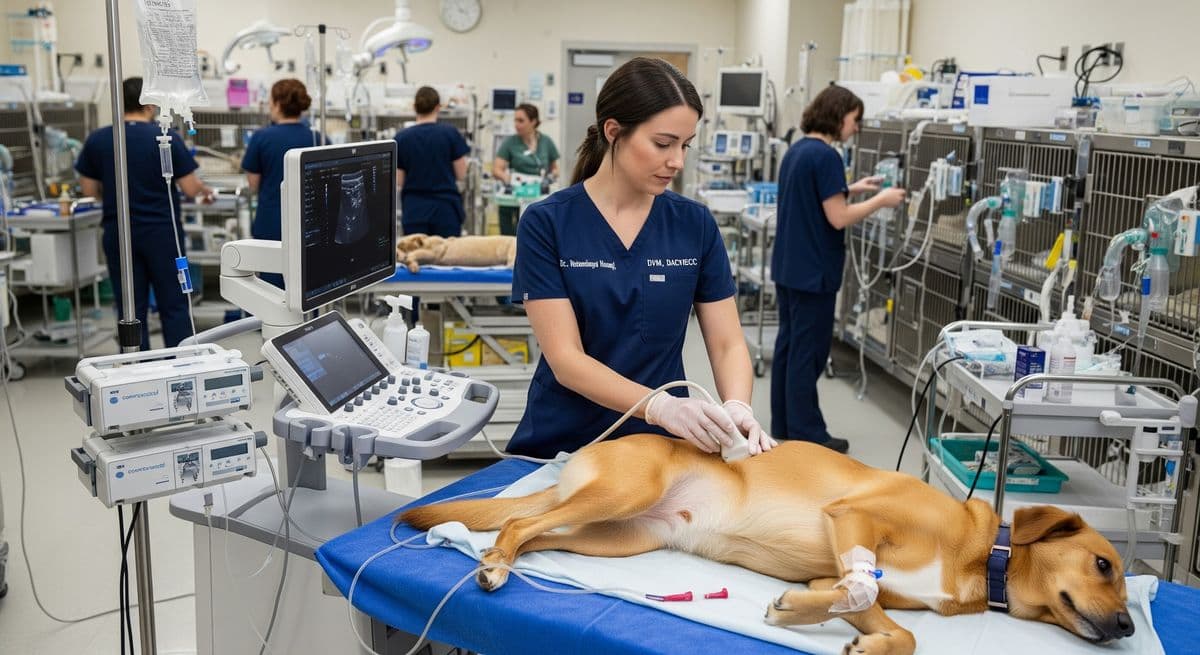
Criticalists work primarily in the Intensive Care Unit (ICU), but their role extends far beyond it. They function as the “glue of the hospital” - essential consultants who collaborate with surgeons, internal medicine specialists, cardiologists, and neurologists to manage the physiological complexities of the most difficult cases. When a pet is in the ICU after major surgery, it is often the criticalist who is watching the body’s moment-to-moment response and adjusting treatment accordingly. (Mathews, 2017)
ℹ Emergency vet vs. veterinary criticalist — what’s the difference?
An emergency veterinarian handles immediate, walk-in stabilization: the first responder of veterinary medicine. They assess, triage, and intervene in the acute phase of an illness or injury, often preventing deterioration or death that may have happened otherwise.
A veterinary criticalist takes over when a pet’s condition is too complex, too unstable, or too multi-systemic to resolve quickly. They manage the ICU, lead the medical team, and make the continuous adjustments that keep a failing body functional long enough to recover.