Dog Anal Gland Problems: Signs, Care, and When to Worry | Vetmodo
Medical Insights
Dog Anal Gland Problems: What Every Owner Should Know
Scooting, licking, and a bothered back end are some of the most common (and most misunderstood) signs of anal gland trouble in dogs. This owner's guide explains what the anal glands do, how to support them with diet and routine care, which warning signs need prompt veterinary attention, and why more expressing is not always better.
4 min read
Written by Vetmodo Editorial Team
Key takeaways
Scooting, excessive licking, or biting near the tail base are often the first signs of anal gland irritation and are worth a veterinary check.
Adequate dietary fiber helps produce firm stools that support natural anal gland emptying, and a higher-fiber food sometimes helps repeat offenders.
Sudden swelling, discharge, blood, or pain near the anus can signal an abscess, which is an urgent problem.
Routine expressing is not needed for every dog and can cause irritation if overdone, so let your veterinarian guide whether and how often it is done.
If your dog has ever dragged their rear across the carpet, you have witnessed one of the most common signs of anal gland irritation. Anal glands are one of those unglamorous parts of dog ownership that many people never think about until something goes wrong. This guide explains what these glands do, how to support them, the warning signs to watch for, and when a trip to the veterinarian is important. It is meant as general education, not a substitute for advice from your own veterinarian, who can assess what is normal for your individual dog.
Trust you can count on.
Articles identify their authors, reviewers, publication dates, and supporting sources when that information is available.
Anal glands, also called anal sacs, are two small scent glands located just inside the anus, at roughly the four o'clock and eight o'clock positions. They produce a distinctive-smelling fluid that is normally released in small amounts when a dog passes a firm stool. This is part of why dogs are so interested in sniffing each other's rear ends: the secretion carries scent information unique to each dog.
In most dogs, these glands empty on their own with normal bowel movements and never need attention. Problems tend to arise when the sacs do not empty properly, become impacted, inflamed, or infected (Corbee et al., 2021).
Signs of Anal Gland Problems in Dogs
Because dogs cannot tell us when their back end is uncomfortable, they show us through behavior. Early signs that the anal glands may be bothering your dog include:
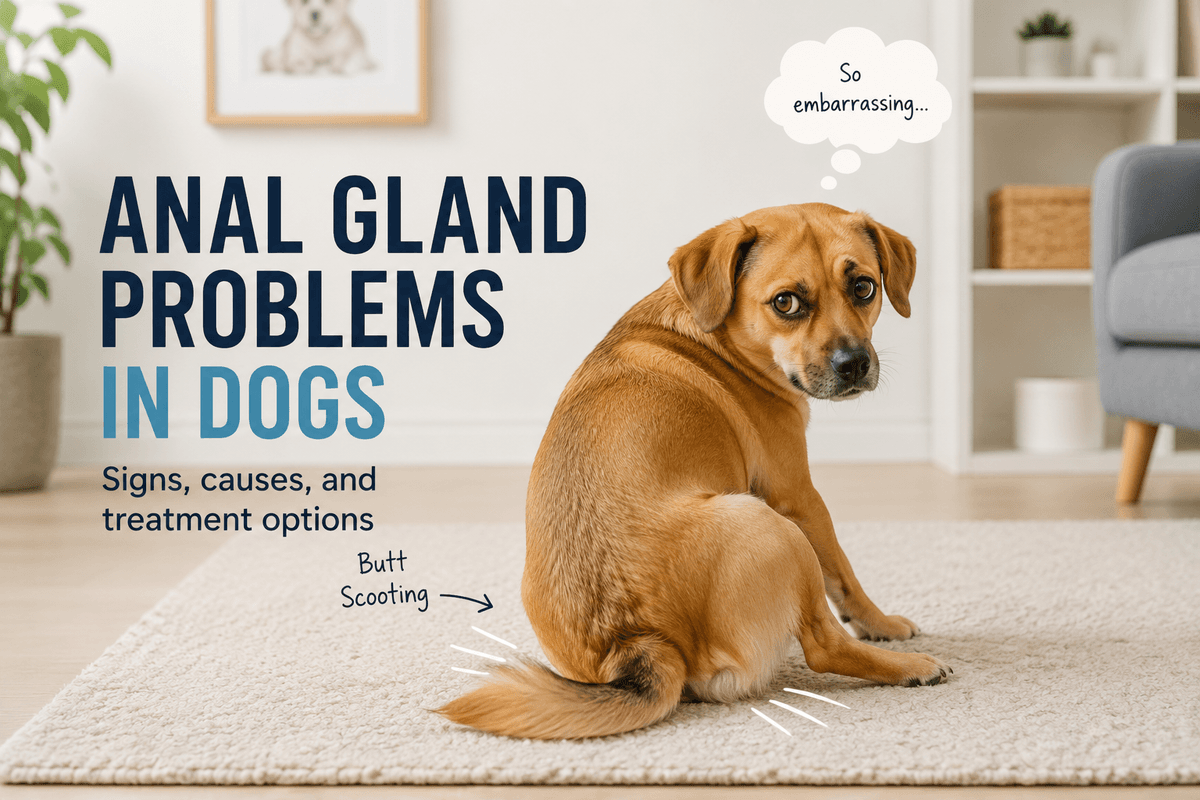
Scooting, or dragging the rear along the floor or grass
Excessive licking or biting at the tail base or under the tail
A strong, fishy odor
Sitting down abruptly or seeming uncomfortable when sitting
Chasing or fixating on the tail, or turning suddenly toward the rear
Redness or swelling around the anus
These signs often appear before a problem becomes serious, so noticing them early gives you a chance to have your dog checked before things escalate. It is worth remembering that scooting can also point to other issues, such as intestinal parasites or skin irritation, which is another reason a veterinary check is helpful rather than assuming it is always the glands.
When Anal Gland Problems Become an Emergency
If impacted glands are not addressed, they can become infected and progress to an abscess, which is a painful, pus-filled swelling that can rupture through the skin. This is a significant step up in severity and warrants prompt veterinary attention (Hvitman-Graflund et al., 2023). Signs that a problem has become urgent include:
Visible swelling, a lump, or a draining wound near the anus
Blood or pus in the area or on bedding
Obvious pain, crying out, or aggression when the area is touched
Reluctance to sit, poop, or move normally
Fever, lethargy, or loss of appetite
An abscess is not a wait-and-see situation. If you notice these signs, contact your veterinarian right away, since infections in this area can worsen quickly and are painful for your dog.
How to Support Healthy Anal Glands With Diet and Fiber
One of the most useful things owners can do is help their dog form firm, bulky stools, because a well-formed stool naturally presses on the anal sacs and helps them empty as it passes. Loose or small stools do not provide that pressure, which is one reason chronically soft stools are linked to recurring anal gland trouble.
Fiber plays a central role here:
Adequate dietary fiber supports firm, bulky stools that help the glands empty naturally
For dogs with repeated issues, a veterinarian may suggest switching to a slightly higher-fiber food or adding a fiber supplement
Emerging research suggests some fiber-containing supplements may help manage recurrent anal sac impaction, though this should be part of a veterinary plan rather than a do-it-yourself fix (Salichs et al., 2025)
Maintaining a healthy weight matters too, since overweight dogs may have more difficulty emptying the glands
Because the right amount and type of fiber depends on your individual dog, it is best to make dietary changes in consultation with your veterinarian rather than loading up on fiber on your own, which can sometimes cause its own digestive upset.
Does My Dog Need Their Anal Glands Expressed?
This is one of the most misunderstood parts of anal gland care. Many dogs go their entire lives without ever needing their glands manually expressed. Routine expressing is not necessary for every dog, and doing it when it is not needed can actually cause problems.
A few important points:
Expressing is for dogs that need it, typically those showing signs of impaction, not a routine grooming step for every dog
Over-expressing can cause irritation and inflammation of the sacs, and may even contribute to a cycle of recurring issues
Whether expressing should be done, and how often, is best guided by your veterinarian, who can show you what is appropriate for your dog
If your dog does need regular expressing, your veterinary team can advise whether it is something to have done professionally or, in some cases, learn to do at home
The takeaway is that more is not better. The goal is healthy, self-emptying glands, and unnecessary manipulation works against that.
Special Considerations for Middle-Aged and Senior Dogs
Owners of middle-aged and older dogs should pay particular attention to changes in this area. While most anal gland issues are benign, tumors of the anal sac can develop, most often in middle-aged to older dogs. Anal sac adenocarcinoma is an uncommon but serious cancer that can be mistaken for an ordinary gland problem in its early stages (Bennett et al., 2002). This is a key reason not to assume that a new lump or persistent problem in an older dog is "just the anal glands." Any firm mass, persistent swelling, or issue that does not resolve deserves a veterinary evaluation.
Certain breeds also have their own distinct considerations. In German Shepherds in particular, a condition called perianal fistula, which involves painful, chronic tunneling sores in the tissue around the anus, is more common and is a separate problem from ordinary anal gland disease (Pye, 2025). It is worth knowing about because the signs can overlap with anal gland irritation, but the condition and its management are quite different, so an accurate diagnosis matters.
Every Dog Is Different
Anal gland health varies widely from dog to dog. Some dogs sail through life without a single problem, while others deal with recurring impactions or infections that need ongoing management (Lundberg et al., 2022). In a small number of dogs with severe, chronic, or recurrent disease, surgical removal of the anal sacs may eventually be recommended, though this is reserved for cases that do not respond to other management. There is no single routine that fits every dog, which is why working with your veterinarian to find the right approach for your individual pet is the most reliable path to keeping them comfortable.
Getting the Right Care for Your Dog's Anal Gland Health
Anal gland problems range from a minor, easily managed nuisance to a genuine emergency, and telling the difference is not always easy from home. Whether you are seeing early signs like scooting or something more concerning like swelling and discharge, a veterinarian can tell you what is actually going on and what your dog needs. If you are looking for a clinic, Vetmodo can help you find and compare veterinary practices near you, so you can get your dog seen promptly and keep this sensitive area healthy and comfortable. Start your search on Vetmodo today.
Frequently Asked Questions
Why is my dog scooting their bottom on the floor?
Scooting is most often a sign of irritation of the rear end, which is commonly due to the anal glands being full, impacted, or irritated. It can also be caused by intestinal parasites or skin irritation, so if it happens more than once or twice, it is worth having your veterinarian check what is going on.
Do all dogs need their anal glands expressed regularly?
No. Many dogs never need manual expressing, because their glands empty naturally with firm stools. Routine expressing when it is not needed can actually irritate the glands, so it is best done only when your veterinarian recommends it.
Can food or fiber really help with anal gland problems?
Yes, indirectly. A high-quality diet with adequate fiber helps produce firm, bulky stools that press on the glands and help them empty naturally. For dogs with recurring problems, a veterinarian may suggest a higher-fiber food or supplement as part of a management plan.
When is an anal gland problem an emergency?
When you see swelling, a lump, a draining wound, blood or pus, or clear signs of pain near the anus, especially with lethargy or loss of appetite. These can indicate an abscess or infection, which is painful and can worsen quickly, so contact your veterinarian right away.
Written by
Vetmodo Editorial Team
Medical disclaimer
This article is educational and does not replace advice, diagnosis, or treatment from a licensed veterinarian. Contact your veterinarian with questions about your pet's health.
Salichs M, Beasley S, Homedes J. Efficacy of an oral chew containing fibre and Bacillus velezensis C-3102 in the management of anal sac impaction in dogs. Vet Dermatol. 2025;36(1):74-82. https://pubmed.ncbi.nlm.nih.gov/39377170/
Vetmodo identifies authors, reviewers, dates, and supporting sources when that information is available.