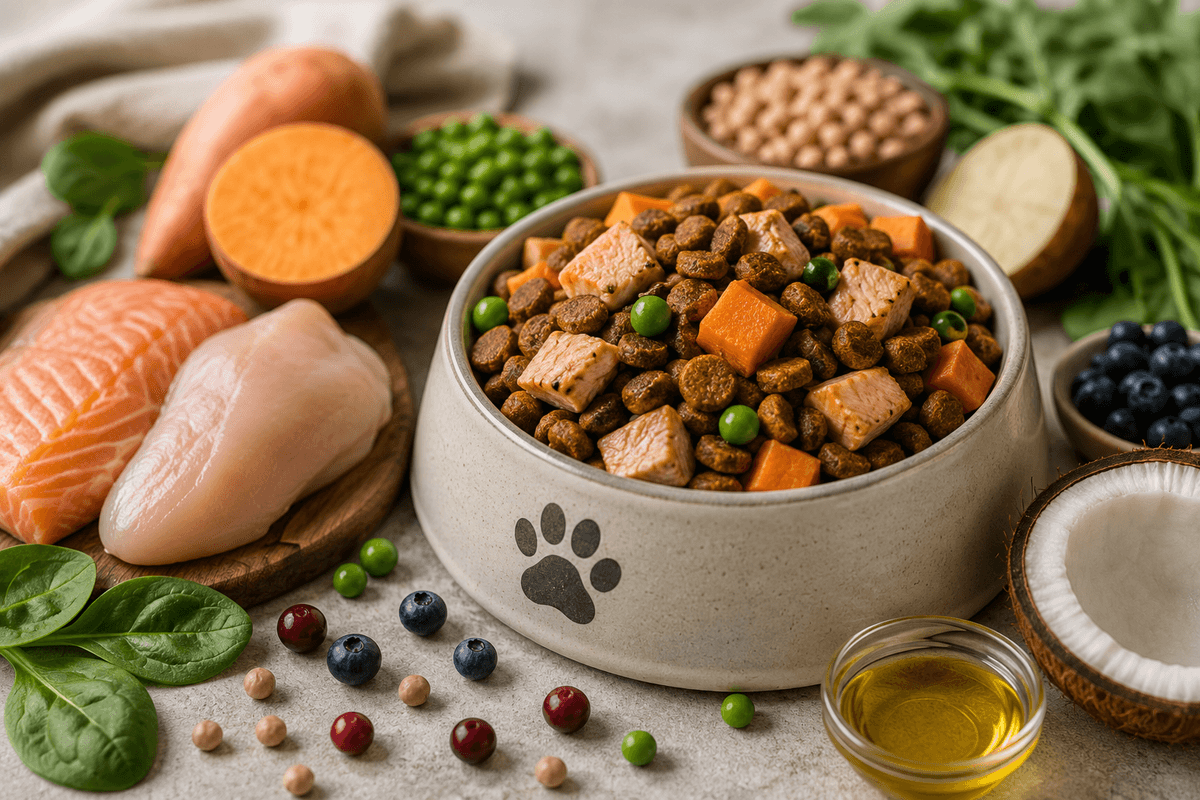
Grain-free dog food has been one of the biggest trends in pet nutrition over the past decade, built on the idea that dogs are closer to wolves than we think and shouldn't be eating carbohydrates at all. It's an appealing story, and pet food marketing has leaned into it. But marketing claims and scientific evidence do not always line up, and grain-free diets are a clear example of a trend that outpaced the research behind it (Freeman et al., 2018). Understanding what the science actually shows, including a well-documented link to a serious heart condition, can help you make a more informed choice for your dog.
Grain-free formulas took off on the premise that dogs are primarily carnivores and aren't well suited to digesting grains like corn, wheat, or rice. Pet food companies marketed grain-free kibble as a more "ancestral" or natural way to feed a dog, and many owners switched in hopes of solving digestive issues, itchy skin, or general health concerns. Surveys of dog owners show that this belief, that grains are somehow inferior or harder to digest, is a major driver of grain-free purchases, even though it isn't well supported by evidence (Banton et al., 2021).
That said, grain-free diets aren't without any potential upside. Some research suggests they may support better blood sugar control and, in certain cases, improved digestibility. However, they are not the cure-all for allergies and sensitivities that marketing often implies (Zhang et al., 2025).
The most serious concern linked to grain-free diets is dilated cardiomyopathy, or DCM, a disease in which the heart muscle weakens and struggles to pump blood effectively. Veterinary researchers have identified a pattern of non-hereditary DCM, meaning it appears in breeds that don't typically develop the condition, in dogs eating certain grain-free diets (Mornard et al., 2025). This connection was significant enough that it prompted a formal FDA investigation.
Several studies have added detail to this picture:
- Rapid heart changes: One trial found that dogs fed a pea-based, grain-free diet for just 28 days developed measurable, subclinical changes in heart function, including reduced stroke volume (Quilliam et al., 2023).
- Reversibility: In multiple cases, dogs with early or subclinical heart abnormalities showed real improvement in cardiac function after being switched from a grain-free diet back to a grain-inclusive one (Haimovitz et al., 2022; Saito et al., 2022).
- The legume connection: The FDA has specifically flagged grain-free formulas that list peas, lentils, or other legumes high on the ingredient panel as the most frequently implicated in non-hereditary DCM cases (FDA, 2024).
- Not all carbohydrates are equal: Research comparing different carbohydrate sources found that some, including certain grains, supported cardiac health and overall wellness better than others, suggesting the issue isn't carbohydrates in general but specific formulations (Morris et al., 2025).
Some brands connected to non-hereditary DCM cases have since reformulated their products to reduce the ingredients most often implicated, though it's still too early for clinical research to confirm whether these changes have lowered the actual rate of heart disease.
One of the most common reasons owners switch to grain-free food is a belief that it will resolve their dog's allergies or skin issues. In reality, grains are a fairly uncommon allergen in dogs. When dogs do have a true food allergy, the reaction is most often triggered by a protein source, such as beef or chicken, not a grain (Verde et al., 2023). This means that for the average dog with itchy skin, ear infections, or GI upset, cutting out grains alone is unlikely to solve the problem, and may just delay finding the actual cause.
Grain-free diets do have a place, but it's a narrow one. They tend to help only the small number of dogs who have a genuine, veterinarian-diagnosed grain sensitivity or intolerance, something that is typically confirmed through a supervised elimination diet trial rather than guesswork at home. Outside of that specific situation, there is little evidence that grain-free feeding offers a meaningful health advantage for the average, healthy dog.
A grain-free diet may be appropriate when:
- Your veterinarian has diagnosed a specific grain intolerance or sensitivity through an elimination diet trial.
- Your dog has a documented reaction to a particular grain ingredient, confirmed through testing rather than assumption.
- Your veterinarian recommends it for a specific, diagnosed medical reason unrelated to general "wellness."
Rather than focusing on whether a food contains grain, a more reliable marker of quality is whether it meets AAFCO (Association of American Feed Control Officials) standards. An AAFCO statement confirms that a food is complete and balanced, meaning it provides everything your dog needs nutritionally for their specific life stage (Cline et al., 2021).
- Growth and reproduction: Puppies and pregnant or nursing dogs need higher levels of specific nutrients to support development.
- Adult maintenance: Focuses on maintaining a healthy weight and preventing chronic disease over the long term.
- Senior: May call for adjustments to protein quality or mineral levels to support aging organs.
Checking for an AAFCO statement, and matching it to your dog's life stage, tells you far more about a food's nutritional adequacy than whether or not it contains grain.
Beyond the AAFCO statement, you can look at who makes the food. The World Small Animal Veterinary Association (WSAVA) publishes nutritional guidelines that help owners identify manufacturers held to a higher standard (WSAVA Nutritional Assessment Guidelines Task Force, 2011). Brands that meet these recommendations typically employ full-time qualified nutritionists, own and control their manufacturing facilities, run rigorous quality-control testing, and conduct feeding trials to confirm their diets perform in real dogs, not just on paper. This matters for the grain-free conversation in particular, because the DCM cases that raised concern were frequently tied to smaller companies that formulated trendy recipes without that depth of nutritional oversight.
WSAVA offers a free guide with the specific questions to ask a manufacturer about their nutritional expertise and quality control (WSAVA Global Nutrition Committee, 2021). Choosing a food that meets both the AAFCO standard and WSAVA's recommendations gives you an extra layer of confidence that what you are feeding is backed by genuine nutritional science.
If you're considering switching your dog to a grain-free diet, or you're not sure whether your current food is the right fit, the best next step is a conversation with your veterinarian rather than a guess based on packaging claims. Vetmodo makes it easy to find a trusted veterinarian near you who can help you evaluate your dog's diet, run a proper allergy or sensitivity workup if needed, and confirm the food you choose meets AAFCO standards for their life stage. Search Vetmodo today to connect with a vet who can guide your next food decision.